

A growing ecommerce brand spent nearly 18 months ordering packaging the same way they had since launch.
Every few weeks, they placed another small order.
Each order required reapproving artwork files. Production timelines varied. Slight size differences appeared between suppliers. Print colors shifted from batch to batch. And every reorder came with higher per-unit costs than the one before.
At first, those inconveniences felt manageable.
As sales grew, they became operational problems.
When the company finally transitioned to wholesale packaging boxes, something interesting happened. The biggest benefit wasn’t the reduction in packaging cost.
It was the reduction in management time.
Fewer emergency orders. Less supplier coordination. Better inventory planning. More predictable packaging quality.
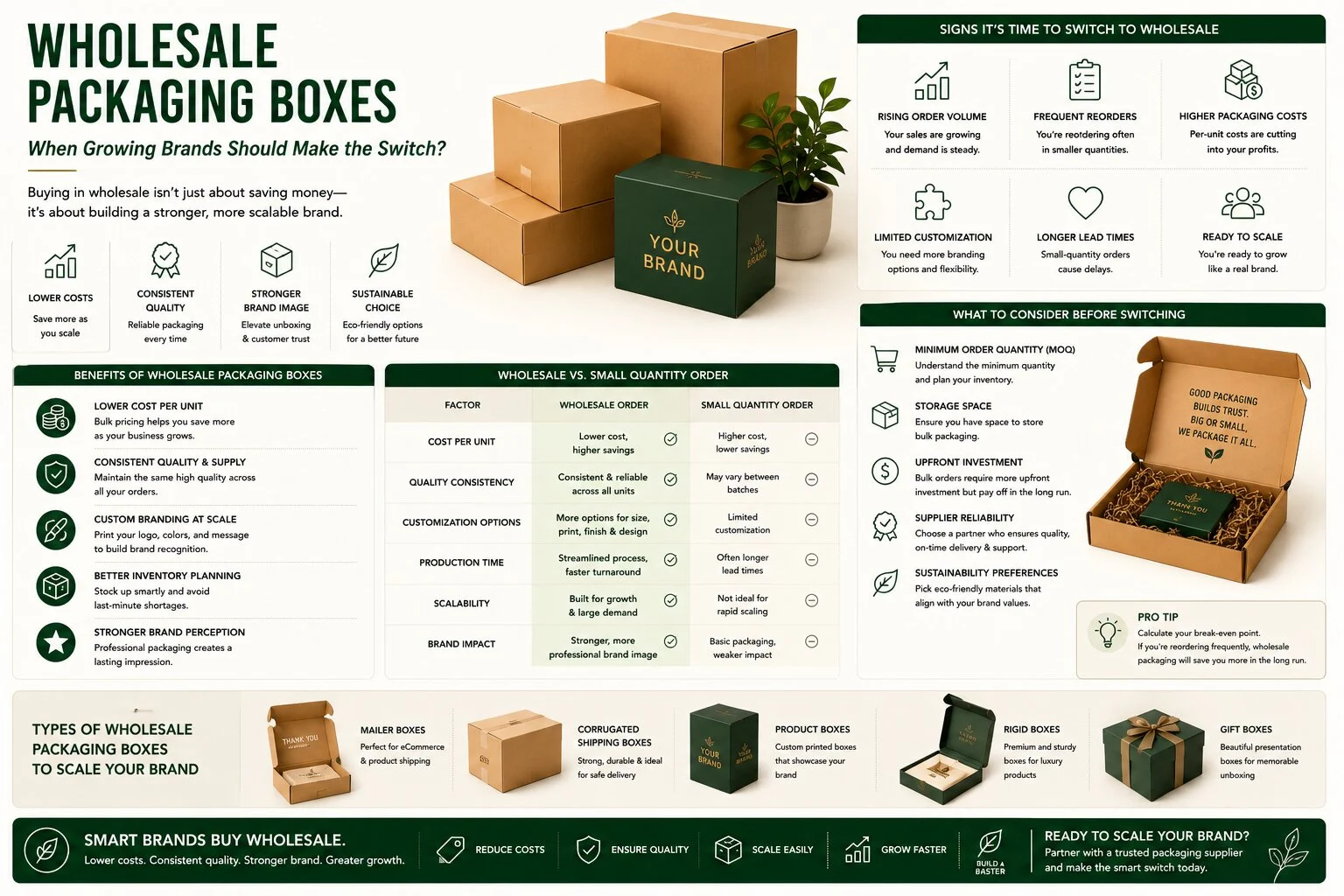
That’s why the decision to move into wholesale packaging isn’t simply about saving money. It’s about building a packaging system that supports growth.
Businesses that transition to wholesale custom packaging typically reduce per-unit packaging costs by 30-50% while simultaneously improving print consistency and operational efficiency.
If you’re wondering whether your business has reached that point, this guide will help you evaluate the signals, calculate the financial impact, and make the transition without disrupting operations.
What Wholesale Packaging Actually Means
Many growing brands hear the term “wholesale packaging” long before they understand what it actually involves.
The distinction matters.
Retail Purchasing vs Wholesale Purchasing
In a retail purchasing model, you’re buying finished packaging products from distributors or resellers.
Those suppliers typically:
- Hold inventory
- Apply markup
- Offer limited customization
- Provide faster small-batch access
Wholesale works differently.
Instead of buying pre-made packaging, you’re ordering directly from manufacturers using custom specifications.
What Wholesale Packaging Enables
Moving to packaging wholesale programs unlocks capabilities that are difficult to achieve through retail purchasing.
These include:
- Custom dimensions fitted precisely to products
- Branded printing built into production
- Consistent quality across every run
- Lower per-unit costs at scale
- Dedicated production scheduling
Many businesses also gain access to structural design support and packaging engineering resources.
What Wholesale Packaging Requires
The benefits come with responsibilities.
Wholesale production typically requires:
- Minimum order quantities (MOQs)
- Artwork preparation
- Production lead times
- Inventory storage
- Upfront purchasing commitments
The Key Distinction
Wholesale isn’t simply ordering more boxes.
It’s ordered differently.
That difference is what creates both the opportunity and the operational advantages.
Signs Your Business Is Ready for Wholesale Packaging
Many companies wait too long.
Others move too early.
The following signals help remove the guesswork.
Signal 1: Reordering Every 2–4 Weeks
Frequent packaging orders usually indicate growing volume.
When you’re placing orders every few weeks, setup costs repeat constantly.
Artwork approvals repeat.
Shipping charges repeat.
Administrative work repeats.
At that point, wholesale economics often begins making sense.
Signal 2: Packaging Quality Varies Between Orders
This issue appears frequently with retail packaging suppliers.
One shipment arrives slightly larger.
The next shipment uses a different board stock.
The following batch has a noticeable color variation.
Those inconsistencies become frustrating as order volume grows.
Wholesale production improves consistency because the same specifications are repeatedly manufactured.
Signal 3: Generic Packaging Is Limiting Brand Growth
Customers rarely say:
“Your packaging cost too little.”
They do say things like:
- “Packaging felt basic.”
- “It looked generic.”
- “Didn’t match the premium price.”
If your products compete in higher-value categories, generic packaging may be limiting perceived value.
Signal 4: You’re Managing Multiple Packaging Suppliers
One supplier for mailers.
Another for inserts.
A third for product boxes.
A fourth for tissue paper.
The coordination burden grows quickly.
Wholesale consolidation often simplifies procurement dramatically.
Signal 5: Seasonal Demand Creates Inventory Anxiety
Holiday seasons expose packaging weaknesses.
Many businesses experience:
- Stock shortages
- Delayed deliveries
- Rush-order costs
Wholesale inventory planning helps eliminate much of that uncertainty.
Signal 6: Shipping Costs Are Growing Disproportionately
Poorly fitted packaging increases dimensional weight charges.
Custom-sized wholesale boxes often reduce:
- Packaging costs
- Shipping costs
at the same time.
For ecommerce businesses, that combination can have a meaningful impact on profitability.
The Real Benefits of Wholesale Packaging Beyond Cost
Most discussions about wholesale boxes focus entirely on savings.
That’s understandable.
It’s also incomplete.
Operational Time Savings
Packaging administration consumes more time than many businesses realize.
Common tasks include:
- Supplier communication
- Artwork approvals
- Reordering
- Inventory tracking
- Rush procurement
Wholesale systems reduce much of that recurring work.
Many growing brands recover 3–5 hours per month in packaging management time alone.
Print and Color Consistency
Consistency matters.
Especially when customers buy repeatedly.
Repeated wholesale production runs maintain:
- Brand colors
- Logo placement
- Material quality
- Structural specifications
This is particularly important for:
- Amazon sellers
- Subscription brands
- Multi-location retailers
Inventory Planning Confidence
Predictability is valuable.
Wholesale production schedules allow businesses to forecast inventory needs more accurately.
Benefits include:
- Fewer emergency orders
- Fewer stockouts
- Better seasonal planning
Supplier Relationship Benefits
Long-term wholesale partnerships often create advantages beyond pricing.
Examples include:
- Priority production scheduling
- Faster support responses
- Design assistance
- Packaging optimization recommendations
Structural Consistency
Custom sizing eliminates product movement inside packaging.
That improves:
- Protection
- Presentation
- Shipping performance
Studies show 72% of consumers say packaging consistency across multiple purchases strengthens their brand trust and repurchase likelihood.
Consistency isn’t just operational.
It’s part of the customer experience.
How to Calculate Whether Wholesale Makes Financial Sense
Before transitioning, run the numbers.
Here’s a simple framework.
Step 1: Calculate Current Annual Packaging Cost
Formula:
Monthly Packaging Spend × 12
Example:
$700 per month × 12 = $8,400 annually
Step 2: Estimate Wholesale Unit Cost
Request a quote for your highest-volume packaging SKU.
Calculate annual cost at your current volume.
Example:
Current annual packaging spend: $8,400
Estimated wholesale spend: $5,600
Potential savings: $2,800
Step 3: Add Inventory Holding Cost
Wholesale inventory requires storage.
A reasonable estimate:
Monthly Carrying Cost = Annual Inventory Value × 2–3%
This accounts for:
- Storage
- Capital allocation
- Inventory risk
Step 4: Calculate Annual Savings
Formula:
Current Cost − Wholesale Cost − Carrying Cost = Annual Savings
Step 5: Add Operational Time Value
Don’t ignore labor savings.
Example:
4 hours saved monthly × $40/hour × 12 months
Annual operational savings:
$1,920
Typical Result
Many businesses find wholesale production becomes attractive when monthly packaging spend exceeds approximately:
$500–$800 per month
When Wholesale Doesn’t Make Sense Yet
Wholesale may not be appropriate if:
- Sales fluctuate dramatically
- Product designs change frequently
- Inventory forecasting remains difficult
Very early-stage businesses often benefit from staying flexible.
Many startups discussed in our small business packaging guide fall into this category initially.
Transitioning to Wholesale — Practical Steps
The process doesn’t need to be complicated.
Step 1: Don’t Switch Everything at Once
Start with your highest-volume packaging SKU.
This minimizes risk and provides a manageable test case.
Step 2: Build a Small Bridge Inventory
Maintain approximately:
2–3 weeks of existing inventory
while wholesale production is underway.
This prevents stockouts during the transition.
Step 3: Get Physical Samples First
Never approve production solely from digital proofs.
Physical samples reveal:
- Color accuracy
- Material feel
- Structural performance
Step 4: Plan Your First Order Conservatively
Order approximately:
8–12 weeks of projected demand
This provides flexibility without excessive inventory risk.
Step 5: Establish a Reorder Trigger
Most successful businesses reorder when:
4–6 weeks of inventory remain
Waiting longer creates unnecessary pressure.
Step 6: Document Specifications
After a successful run, document:
- Dimensions
- Materials
- Finishes
- Print standards
Future reorders become much simpler.
Wholesale Packaging for Different Business Types
Different industries benefit from wholesale production in different ways.
Ecommerce Brands
Primary need:
Consistent shipping packaging.
Wholesale focus:
- Corrugated mailers
- Product cartons
- Inserts
Key benefit:
Shipping cost optimization through right-sized packaging.
Many ecommerce companies eventually expand into custom mailer boxes to further improve efficiency and branding.
Subscription Businesses
Primary need:
Reliable monthly packaging availability.
Wholesale focus:
- Mailer boxes
- Tissue systems
- Inserts
Key benefit:
Inventory predictability.
Multi-Location Retailers
Primary need:
Consistent packaging across all stores.
Wholesale focus:
- Retail cartons
- Display packaging
Key benefit:
Uniform brand presentation.
Food and Beverage Brands
Primary need:
Food-safe packaging at scale.
Wholesale focus:
- Bakery packaging
- Gable boxes
- Food cartons
Key benefit:
Consistent compliance and freshness performance.
Cannabis Brands
Primary need:
Reliable compliant packaging.
Wholesale focus:
- Pre-roll packaging
- Cartridge boxes
- Display systems
Key benefit:
Regulatory consistency across production runs.
Common Wholesale Packaging Mistakes
The transition becomes much easier when you avoid common mistakes.
Mistake 1: Ordering Too Much Too Soon
Large inventory commitments create risk if designs change.
Start conservatively.
Mistake 2: Skipping Physical Samples
Digital proofs cannot accurately show:
- Material texture
- Print quality
- Structural performance
Always sample first.
Mistake 3: Ignoring Lead Times
Wholesale production requires planning.
Businesses accustomed to retail ordering often underestimate lead times and create avoidable stockouts.
Mistake 4: Changing Designs Too Frequently
Frequent design revisions undermine the efficiency of wholesale production.
Stabilize branding before scaling volume.
Mistake 5: Using One Supplier for Everything Without Vetting
Consolidation can be beneficial.
Moving too quickly creates risk.
Evaluate suppliers carefully before centralizing production.
Conclusion
The decision to adopt wholesale packaging boxes is ultimately about operational readiness as much as purchase volume.
When you begin experiencing frequent reorders, inconsistent packaging quality, supplier complexity, and growing brand expectations, wholesale production often creates measurable improvements across the business. Lower costs matter, but the operational benefits—better planning, stronger consistency, reduced management time, and improved customer experience—often become even more valuable over time.
Explore our custom packaging boxes wholesale programs designed for growing brands across retail, ecommerce, and subscription businesses in the United States.