

Imagine you’re a brand manager reviewing sales reports from two retail locations.
Both stores carry the same product.
Both sell it at the same price.
Both serve similar customer demographics.
Yet one location consistently outsells the other by 40–60%.
After digging into the data, you discover something interesting.
Location A places the product on a standard shelf alongside competitors.
Location B places the exact same product in a dedicated POP display packaging system near the checkout area.
The product didn’t change.
The price didn’t change.
The retailer didn’t change.
The display changed.
This is why point-of-purchase merchandising remains one of the most powerful tools available to consumer brands. Unlike many marketing investments, POP displays create measurable sales impact because they influence customers at the exact moment purchase decisions occur.
Point-of-purchase displays generate up to $0.20 additional revenue per shopping trip according to POPAI retail research, making strategic display placement one of the highest-ROI investments in retail merchandising.
If you work with retailers, understanding POP display strategy can directly influence sell-through rates, retailer relationships, and long-term shelf expansion opportunities.
What POP Display Packaging Actually Is
Many brands hear the term POP display without fully understanding how it differs from ordinary packaging.
POP stands for Point of Purchase.
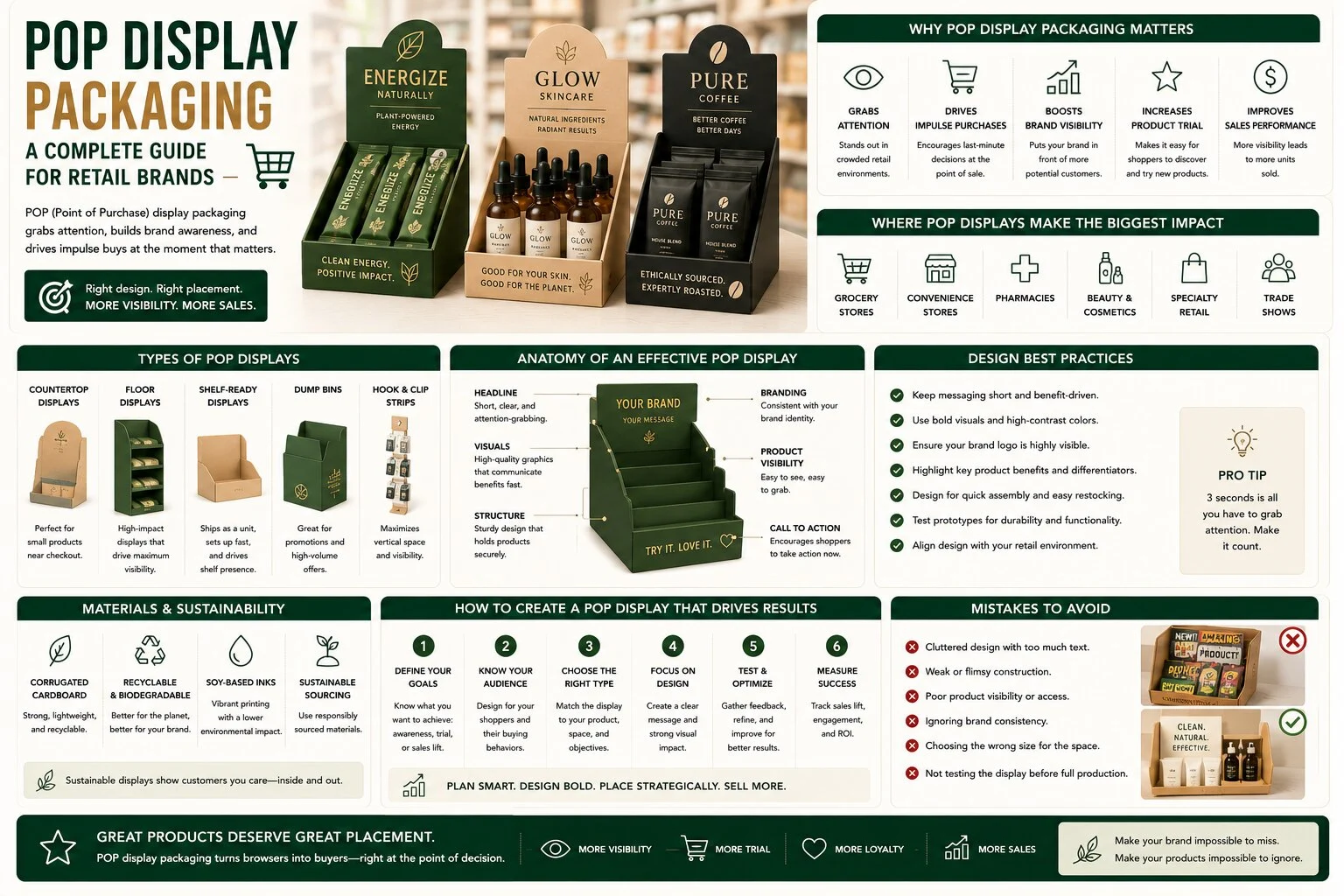
POP display packaging refers to packaging structures specifically designed to merchandise products in highly visible retail locations where customers make purchasing decisions.
Standard packaging and POP displays serve different purposes.
Standard Packaging
Traditional packaging is designed to:
- Protect products
- Communicate product information
- Display branding
- Facilitate transportation and storage
POP Display Packaging
POP displays do all of the above while also functioning as retail sales tools.
Their purpose is to:
- Attract attention
- Increase visibility
- Encourage impulse purchases
- Improve product accessibility
- Support promotional campaigns
Common POP Display Locations
Retailers place POP displays in areas with elevated customer traffic, including:
- Checkout counters
- Endcap positions
- Main floor aisles
- Freestanding retail islands
- Pharmacy consultation areas
- Boutique feature sections
One important reality often surprises brands:
A mediocre display placed in a high-traffic checkout location frequently outperforms an excellent display hidden in a low-traffic area.
Placement and design must work together.
Types of POP Display Packaging
Different retail environments require different display formats.
Understanding the major display categories helps brands select structures that align with their products and retail goals.
Countertop POP Displays
Countertop displays sit on checkout counters, reception desks, pharmacy counters, and service stations.
Best for:
- Cosmetics
- CBD products
- Supplements
- Accessories
- Travel-size products
- Small impulse purchases
Why they work:
Customers waiting in line naturally scan nearby merchandise.
This creates valuable impulse-buy opportunities.
Structural requirements include:
- Compact footprint
- Reinforced walls
- Easy restocking access
- High product visibility
For deeper checkout-focused merchandising strategies, many brands also reference guidance from Blog 4 on Counter Display Boxes.
Floor Standing POP Displays
Floor displays are freestanding retail structures positioned throughout the sales floor.
Best for:
- Product launches
- Seasonal promotions
- High-volume SKUs
- Multi-product collections
Why they work:
They can be seen from multiple directions and often create dedicated brand presence within a store.
Structural requirements include:
- Strong base stability
- Reinforced corrugated construction
- Eye-level header cards
- Anti-tip engineering
Endcap Displays
Endcaps occupy the ends of retail aisles.
These positions often receive the highest customer traffic in grocery, pharmacy, and mass retail environments.
Best for:
- Seasonal campaigns
- New product introductions
- Category leadership positioning
- Brand-focused merchandising
Why they work:
Customers naturally look toward aisle endings while navigating stores.
Sidekick Displays
Sidekicks attach directly to existing fixtures.
Best for:
- Cross-selling opportunities
- Complementary products
- Accessories
- Add-on purchases
Examples include:
- Lip balm near cosmetics
- Protein bars near supplements
- CBD accessories beside wellness products
Their strength comes from contextual placement.
Gravity Feed Displays
Gravity feed systems automatically move products forward as inventory is removed.
Best for:
- Candy
- Single-serve snacks
- Supplement packets
- Small packaged goods
Why they work:
The display always appears full, even as inventory decreases.
This reduces maintenance and improves presentation.
Pallet Displays
Pallet displays combine shipping and merchandising into one unit.
Best for:
- Warehouse retailers
- Club stores
- High-volume consumer products
- Promotional bulk items
They minimize labor while maximizing retail visibility.
Designing POP Displays That Perform in Retail
Many displays fail despite strong graphics because they overlook practical retail realities.
The most successful POP display design combines visual appeal with operational functionality.
Header Cards That Work at Distance
Your header card is often the first thing shoppers notice.
Customers should understand three things within seconds:
- What category the product belongs to
- Why they should stop
- Which brand they’re seeing
A common mistake is overcrowding header cards with text.
If shoppers can’t read it from ten feet away, it’s too complicated.
Color Contrast Against the Retail Environment
Displays should stand out.
Before finalizing graphics, evaluate the retail environment.
A display that blends into store fixtures becomes invisible.
Successful brands design for contrast rather than personal preference.
Product Visibility
Products should remain visible without requiring customers to pick them up.
Techniques include:
- Face-forward merchandising
- Tiered product placement
- Window cutouts
- Open-front display structures
Visibility directly influences engagement.
Structural Durability
POP displays often remain on the sales floor for four to twelve weeks.
Daily customer interaction creates wear.
Corrugated structures with appropriate board grades typically provide the durability required for most retail programs.
Restocking Ease
Retail employees are busy.
If restocking becomes frustrating, displays often get abandoned or removed.
Design should include:
- Rear access panels
- Open loading systems
- Clear inventory visibility
Height Engineering
Product placement matters.
Displays positioned too low require bending.
Displays positioned too high create accessibility issues.
Ideal placement typically falls between waist and eye level.
Customers engage more naturally within this zone.
POP Display Compliance with Retail Partners
One of the most overlooked aspects of retail display packaging is retailer compliance.
Many brands design beautiful displays only to discover they violate retailer requirements.
Common Retailer Requirements
Retailers frequently specify:
- Maximum dimensions
- Height limits
- Structural performance standards
- Assembly procedures
- Restocking requirements
- Brand approval processes
Ignoring these specifications creates expensive delays.
Getting Specifications Early
Before designing anything, request retailer standards documentation from your buyer.
This simple step prevents redesign costs and approval issues.
Understanding Approval Timelines
Retailers often require display approval 8–12 weeks before placement.
This timeline must be incorporated into production planning.
Brands that submit display specifications compliant with retailer standards on first submission reduce time-to-shelf by an average of 4–6 weeks compared to brands requiring multiple revision rounds.
The retailer relationship matters as much as the display itself.
POP Display ROI – How to Measure Whether It’s Working
Many brands invest heavily in displays but never measure performance.
That’s a mistake.
Sell-Through Rate Comparison
Compare:
- Shelf performance
- Display performance
Track units sold per week before and after display placement.
This often reveals the clearest sales lift.
Retailer Reorder Frequency
Strong displays typically increase reorder speed.
Faster reorders indicate stronger display effectiveness.
Retail Staff Feedback
Store employees see customer interactions every day.
Ask them:
- Which displays attract attention?
- Which displays get ignored?
- Which displays require maintenance?
The feedback is often valuable.
Display Condition Reporting
Damaged displays provide useful information.
They may indicate:
- High customer interaction
- Structural weaknesses
- Restocking problems
Either way, the data is useful.
Refresh Timing
Most displays show measurable performance improvements within two to four weeks.
After eight to twelve weeks, performance often declines as shoppers become accustomed to the display.
Seasonal refreshes help maintain effectiveness.
POP Display Packaging for Different Categories
Different categories require different display strategies.
Cannabis and CBD Brands
Dispensaries benefit from:
- Counter displays
- Tiered merchandising
- QR code integration
- Educational messaging
Compliance requirements should be integrated directly into display design.
Many CBD-focused brands also benefit from strategies discussed in Blogs
Beauty and Cosmetics
Beauty displays perform best when they include:
- Tiered product organization
- Tester integration
- Premium finishes
- Seasonal refresh programs
Presentation quality strongly influences beauty purchasing decisions.
Supplement and Wellness Brands
Supplements often perform well in:
- Pharmacy displays
- Health food stores
- Wellness-focused retail environments
Header cards should prioritize product benefits and customer outcomes.
Food and Snack Brands
Food products benefit from:
- Gravity-feed displays
- Countertop placements
- Bold color systems
- High-visibility graphics
The objective is immediate recognition and impulse conversion.
Conclusion
Successful POP display packaging depends on three factors, in order of importance: placement location, structure durability, and design clarity.
Many brands focus exclusively on graphics, but retail success usually begins with securing the right location and ensuring the display can survive weeks of customer interaction. Once those fundamentals are in place, strong design amplifies results.
If you’re new to POP programs, start small. Test a countertop display with a single retail partner before investing in large floor-standing programs. This approach allows you to measure ROI, gather retailer feedback, and refine your merchandising strategy before scaling.
Explore our custom display boxes and POP display systems designed for retail brands across dispensaries, pharmacies, boutiques, and specialty retail environments throughout the United States.