
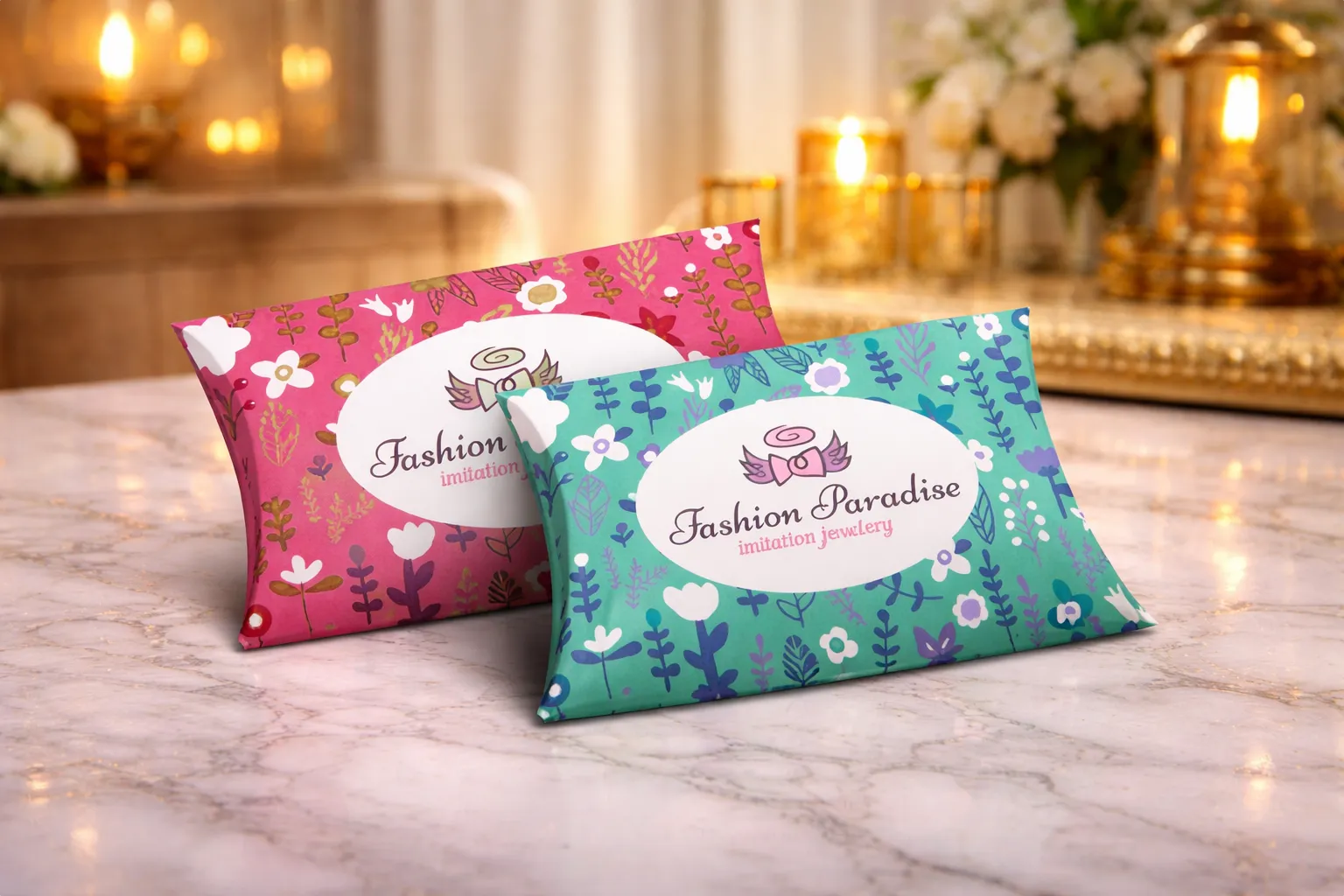
Custom printed pillow boxes USA are curved, pillow-shaped paperboard packaging containers printed with a brand’s logo, colors, and custom artwork — manufactured in the United States or for the US market in materials including kraft, SBS white board, and coated art paper, using printing methods including CMYK digital printing, offset printing, screen printing, and flexographic printing. They are used by jewelry brands, cosmetics businesses, candy retailers, gifting companies, and event planners to create branded, premium-feel packaging at accessible price points.
Printing is what transforms a plain pillow box into a brand asset. The difference between a generic kraft pillow box and a custom printed pillow box with your logo, brand colors, and strategic design is the difference between anonymous packaging and packaging that works as a marketing tool — building recognition, communicating quality, and driving purchase decisions every time a customer encounters it.
This complete guide focuses specifically on the printing and design side of custom pillow boxes — covering every printing method available, how to prepare artwork correctly, how to design for the curved pillow box surface, color strategy, logo placement, and a step-by-step process for getting your custom printed pillow boxes produced and delivered across the USA.
What Makes Custom Printed Pillow Boxes Different from Plain Pillow Boxes?
Custom printed pillow boxes differ from plain pillow boxes in one fundamental way: they carry the brand’s visual identity — logo, colors, typography, and design — printed directly onto the box surface, transforming a functional packaging container into a brand communication tool.
A plain pillow box protects and presents a product. A custom printed pillow box does all of that and also:
- Identifies the brand immediately to anyone who sees the box
- Communicates product quality through the quality of the print and finish
- Builds brand recognition that compounds with every box produced and sold
- Creates a consistent, professional brand experience from the product to the packaging
- Functions as passive advertising every time the box is seen by someone other than the direct customer
The printing specification — the method used, the colors chosen, the finish applied, and the accuracy of the artwork — determines how well the box performs all of these functions. Understanding your printing options is therefore not a technical detail; it is a strategic brand decision.
Key Custom Pillow Box Printing Terms You Need to Know
CMYK (Cyan, Magenta, Yellow, Key/Black): The four-color subtractive color model used in standard commercial printing. All full-color printed designs — photographs, complex gradients, multi-color logos — are reproduced by layering these four ink colors in varying densities. CMYK is the default printing model for custom pillow boxes.
PMS (Pantone Matching System): A standardized color system that assigns a unique number to each specific color, allowing that exact color to be reproduced consistently across different print runs, suppliers, and substrates. Critical for brands where specific brand colors — a specific shade of blue, a precise warm red — must match exactly and consistently across all packaging.
RGB (Red, Green, Blue): The color model used by digital screens — computers, phones, tablets. RGB colors cannot be reproduced directly by CMYK printing. All digital artwork created in RGB must be converted to CMYK before printing. Colors that appear vivid on screen may print differently in CMYK — particularly highly saturated blues, greens, and purples.
Digital Printing: A printing process that transfers digital files directly onto the packaging surface without physical printing plates. Enables full-color, photographic-quality output on short runs with fast setup and no plate costs. The most flexible method for short-run custom printed pillow boxes.
Offset Printing: A printing method that transfers ink from a metal plate to a rubber blanket and then to the printing surface. Produces the highest color accuracy and finest detail of any commercial printing method. Most cost-effective at high volumes (typically 1,000+ units) where the plate setup cost is amortized across a large run.
Flexographic Printing: A high-speed rotary printing process using flexible relief plates and fast-drying inks. The standard method for high-volume, cost-efficient printing on packaging materials. Best for bold, simple designs in limited colors. Not ideal for fine detail or photographic imagery.
Screen Printing: A printing process that pushes ink through a mesh stencil directly onto the surface. Produces vivid, opaque colors and is highly effective for bold brand marks on kraft pillow boxes. Particularly useful for white or light-colored printing on dark or natural kraft substrates.
White Ink Printing: An opaque white ink printed as a base layer on dark, colored, or kraft substrates before CMYK color layers are applied on top. Essential for accurate full-color printing on unbleached brown kraft — without a white ink base, CMYK colors appear muted and warm because the brown substrate shows through.
Dieline: The flat, two-dimensional template showing the exact cut lines, fold lines, and dimensions of the pillow box before assembly. All custom artwork must be designed within the dieline to ensure correct placement when the box is assembled. Always request the specific dieline for your box size before creating artwork.
Bleed: Extra artwork that extends beyond the cut line of the dieline — typically 3mm on all sides. Ensures that when the die-cutting process cuts the box to shape, there are no white unprinted edges visible at the cut margins. All custom pillow box artwork must include a proper bleed.
Safe Zone: The area inside the cut line — typically 3mm in from the edge — within which all critical design elements (logos, text, barcodes) must be placed. Elements outside the safe zone risk being cut off during the die-cutting process.
DPI (Dots Per Inch): The resolution measurement for printed imagery. Print-ready artwork must be a minimum of 300 DPI at the actual print size. Artwork at screen resolution (72 DPI) will appear blurry and pixelated when printed. Always confirm your artwork is 300 DPI before submitting.
Vector Artwork: Artwork created in vector-based software (Adobe Illustrator, CorelDRAW) using mathematical paths rather than pixels. Vector files can be scaled to any size without loss of quality — the industry standard for logos, brand marks, and typography submitted for printing. Common vector formats: .AI, .EPS, .SVG, .PDF.
Raster Artwork: Pixel-based imagery (photographs, textured backgrounds) created in software such as Adobe Photoshop. Raster files have a fixed resolution and lose quality when enlarged. Suitable for photographic elements in print artwork but must be provided at 300 DPI minimum.
Lamination: A thin film applied to the printed surface of the pillow box after printing. Provides surface protection and a specific tactile and visual finish — gloss, matte, or soft-touch. Applied after printing and before die-cutting.
Spot UV: A high-gloss varnish applied selectively over specific areas of the printed and laminated surface using UV curing. Creates a visual contrast between high-gloss and matte areas — particularly effective for logos and brand marks on matte pillow boxes.
Foil Stamping: A hot-stamping process that applies metallic or pigmented foil to the box surface using a heated die under pressure. Available in gold, silver, rose gold, copper, holographic, and custom colors. Not a printing process — applied as a separate finishing step after printing and lamination.
Printing Methods for Custom Pillow Boxes: A Full Comparison
The four main printing methods for custom printed pillow boxes in the USA are digital printing, offset printing, flexographic printing, and screen printing — each with different strengths in terms of color quality, minimum quantities, cost efficiency, and design complexity capability.
| Printing Method | Best For | Minimum Quantity | Color Capability | Detail Level | Cost at Low Volume | Cost at High Volume |
|---|---|---|---|---|---|---|
| Digital Printing | Short runs, complex designs, prototypes | 1+ | Full CMYK + white ink | Excellent — photographic | Low per unit | Higher per unit |
| Offset Printing | High volume, premium color accuracy | 500–1,000+ | Full CMYK + PMS | Excellent — finest detail | High (plate costs) | Low per unit |
| Flexographic | High volume, bold simple designs | 1,000+ | 1–6 colors | Good for bold designs | High (plate costs) | Very low per unit |
| Screen Printing | Bold designs, opaque ink on kraft | 50–200+ | 1–4 colors | Good for solid colors | Moderate | Moderate |
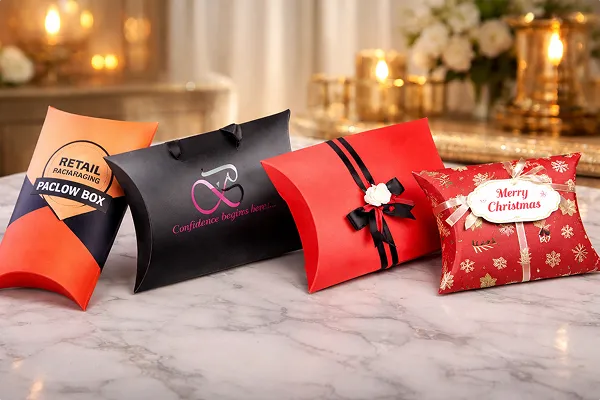
Digital Printing — Best for Short Runs and Design Flexibility
Digital printing is the most accessible and flexible printing method for custom pillow boxes. Because it requires no physical printing plates, there is no plate setup cost — making it ideal for orders of any quantity, including very small runs for product launches, seasonal editions, and test orders.
Digital printing reproduces full-color CMYK artwork, white ink, and photographic imagery with excellent accuracy. It is the standard method for brands ordering fewer than 500 pillow boxes and for any application requiring variable data — different designs, different names, or different product variants in a single production run.
When to choose digital printing:
- Orders under 500 units
- Complex, full-color designs with gradients or photographic elements
- Multiple design variants in one run
- Prototype and sample production before committing to a large offset run
- Short-turnaround urgent orders
Offset Printing — Best for High Volume and Premium Color Accuracy
Offset printing produces the highest color accuracy and finest printed detail of any commercial method. It is the industry standard for premium retail packaging produced in large quantities — where the plate setup cost is amortized across thousands of units and the per-unit cost becomes very competitive.
For custom printed pillow boxes with photographic imagery, complex brand designs, or PMS-matched brand colors, offset printing delivers the most precise and consistent results across large production runs.
When to choose offset printing:
- Orders of 1,000+ units
- Designs with precise PMS color requirements
- Photographic imagery or highly detailed artwork
- Premium cosmetic, jewelry, or luxury gifting pillow boxes
- Ongoing production runs where consistent color matching across batches is critical
Flexographic Printing — Best for High Volume Simple Designs
Flexographic printing is the most cost-efficient method for high-volume pillow box production with relatively simple, bold designs. It uses flexible relief printing plates and fast-drying inks — producing reliable results for logos, text, and simple graphic elements in 1 to 6 colors.
For kraft pillow boxes with a simple logo in one or two colors — the standard aesthetic for organic food, artisan soap, and sustainable retail brands — flexographic printing delivers excellent results at the lowest per-unit cost at scale.
When to choose flexographic printing:
- Orders of 1,000+ units
- Simple logo or brand mark designs in 1–4 colors
- Kraft pillow boxes for artisan or organic brands
- Cost-sensitive high-volume production runs
Screen Printing — Best for Bold, Opaque Color on Kraft
Screen printing pushes opaque ink through a mesh stencil directly onto the pillow box surface. It excels at producing vivid, fully opaque colors — particularly white and light-colored printing on dark or natural kraft substrates where other methods struggle to achieve true opacity.
For brands that want a clean white or bright color logo on a natural brown kraft pillow box without a full-coverage white ink base layer (the digital printing approach), screen printing is often the most visually effective method.
When to choose screen printing:
- Bold, simple logo designs on natural kraft
- White or light color ink on dark substrates
- Artisan, handmade, and organic brand aesthetics
- Short to medium run quantities (50–500 units)
How to Design Custom Printed Pillow Boxes: Step-by-Step
Designing custom printed pillow boxes correctly requires working from the specific dieline for your box size, using CMYK color mode at 300 DPI, including proper bleed and safe zones, and designing specifically for the curved pillow box surface rather than treating it as a flat rectangular package.
Step 1: Request Your Dieline
Before opening any design software, request the exact dieline for your specific pillow box size from U Custom Packaging. The dieline is a PDF or AI template showing the precise dimensions, cut lines, fold lines, and panel arrangement of your box. Every piece of artwork must be created within this dieline — not a generic pillow box template from the internet, which may have different dimensions.
Step 2: Set Up Your Artwork File Correctly
Open the dieline in Adobe Illustrator or your preferred design software. Set the document color mode to CMYK (not RGB). Set the resolution for any raster elements (photographs, textures) to 300 DPI minimum. Add 3mm bleed beyond all cut lines. Establish the safe zone 3mm inside all cut lines and ensure all critical design elements — your logo, product name, any text — remain within the safe zone.
Step 3: Design for the Curved Surface
The pillow box is not a flat rectangle — it is a curved surface. Elements that are designed as if the box were flat will appear distorted or misaligned when the box is assembled. Key principles for curved-surface design:
- Center your logo on the main face panel — this is the primary brand surface and should carry your most important single visual element
- Keep typography horizontal and centered — diagonal or flowing text appears misaligned on the curved surface
- Allow adequate margin between the design edge and the box fold lines — the curve compresses the apparent visual space near the edges
- Avoid placing critical text or design elements too close to the tuck-in ends — these areas curve significantly and text placed here can become difficult to read
Step 4: Choose Your Color Strategy
Your color decisions for custom printed pillow boxes should be driven by the substrate (white board vs kraft) and your brand positioning:
On white SBS board:
CMYK colors reproduce accurately and vividly. Full-color photography, complex gradients, and multi-color brand designs all perform well. Use your full brand color palette.
On natural kraft board:
The brown substrate significantly affects color perception. Dark inks (black, navy, forest green, burgundy) work well directly on kraft without a white base. Light colors (pastels, yellows, whites) require a white ink base layer to appear accurately. Without a white base, all colors shift warmer and more muted — which some brands use intentionally for an artisan aesthetic.
PMS color matching:
If your brand has specific Pantone colors, specify them by PMS number rather than relying on CMYK approximation. PMS matching is available through offset and spot color printing and ensures your brand colors are reproduced consistently across every production run.
Step 5: Place Your Logo Correctly
Logo placement on custom printed pillow boxes follows three principles:
Visibility: The logo should be positioned on the largest face panel of the pillow box — centered both horizontally and vertically — where it is most visible when the box is held or displayed.
Scale: The logo should be large enough to read clearly at arm’s length but not so large that it overwhelms the other design elements. A general rule: the logo should occupy 25–40% of the main face panel.
Exclusion zone: Maintain clear space around the logo — empty space between the logo and any other design elements — equal to at least the height of the capital letter in your logo mark. This prevents the logo from appearing crowded and ensures it reads clearly against the background.
Step 6: Design the Secondary Panels
The pillow box has four printable surfaces: the front face, the back face, and the two end panels (the curved tuck-in areas). Use them strategically:
Front face: Primary brand surface — logo, product name, key product descriptor or benefit
Back face: Secondary information — brand story, usage instructions, website, QR code, social handles, sustainability messaging
End panels: These are often overlooked but are visible when boxes are stored in a drawer or displayed on a shelf end-on. A simple repeated brand mark or color treatment on the end panels is an effective low-cost design detail
Step 7: Select and Specify Your Finish
Finishes are specified separately from the print artwork but must be planned during the design phase because they affect how the artwork will look:
- Matte lamination — reduces color saturation slightly but adds a sophisticated, premium quality. If matte is your intended finish, slightly increase the saturation and vibrancy of your CMYK colors in the artwork file to compensate
- Gloss lamination — amplifies color vibrancy and contrast. CMYK colors on gloss-laminated white board appear richer and more saturated than on uncoated or matte-finished surfaces
- Soft-touch lamination — the most premium feel. Colors appear slightly muted, similar to matte. The tactile quality compensates for this and is the dominant brand signal
- Spot UV — plan your spot UV areas in the design phase. The spot UV layer is typically a separate file showing which areas receive the gloss treatment — usually the logo or a specific graphic element
Color Theory for Custom Printed Pillow Boxes
The most effective color strategies for custom printed pillow boxes use the color’s psychological associations deliberately — selecting palettes that reinforce the product’s positioning and the target customer’s emotional expectations, rather than defaulting to brand colors without considering how they translate to the pillow box format.
Colors and Their Brand Associations in Packaging
Black and gold: The universal luxury signal. Black matte lamination with gold foil stamping is the most recognizable premium pillow box aesthetic — used across jewelry, cosmetics, chocolate, and premium gifting.
White and silver: Clinical precision, purity, and modern minimalism. Effective for skincare, medical-grade cosmetics, and wellness brands targeting a precision-focused consumer.
Natural kraft with dark ink: Authenticity, craftsmanship, and environmental responsibility. The dominant aesthetic in organic food, handmade soap, artisan candy, and sustainable retail.
Pastels (blush, mint, lavender): Softness, femininity, and approachability. Standard in wedding favor packaging, baby gift products, and accessible cosmetics targeting younger demographics.
Bold saturated primaries: Energy, fun, and accessibility. Effective for candy, children’s products, event favors, and brands targeting a young, expressive consumer.
Deep jewel tones (navy, emerald, burgundy, plum): Premium quality with warmth and depth — different from the starkness of black but equally communicative of value. Popular in chocolate, premium candles, and boutique jewelry.
Managing Color Shift Between Screen and Print
The most common problem brands encounter with custom printed pillow boxes is that the printed colors look different from what was designed on screen. This happens because:
- Screens use RGB color (additive color — light) while printing uses CMYK (subtractive color — ink)
- Monitor calibration varies — what looks correct on one screen may look different on another
- Coatings affect perceived color — matte lamination slightly mutes colors while gloss amplifies them
- The substrate affects color — the same CMYK values print differently on white board vs kraft
How to prevent color shift:
- Always design in CMYK color mode from the start — never convert an RGB file to CMYK at the end
- If specific brand colors are critical, specify them by PMS number and request PMS-matched printing
- Request a printed proof or color proof before approving full production
- Calibrate your monitor using a hardware calibration tool if color accuracy is a regular concern
Logo Printing Options for Custom Pillow Boxes
The four main logo printing options for custom pillow boxes are CMYK process printing, PMS spot color printing, foil stamping, and embossing/debossing — each producing a different visual quality and serving different brand positioning requirements.
CMYK Process Logo Printing
The most common method. Your logo’s colors are reproduced by mixing CMYK inks. Works well for logos with multiple colors, gradients, or photographic elements. Color accuracy depends on artwork preparation quality and the printing method used (digital vs offset).
Best for: Multi-color logos, gradient logos, full-color brand marks, affordable full-color printing at any quantity.
PMS Spot Color Logo Printing
Specific Pantone ink colors are mixed to match your exact brand colors and printed as a single spot color layer. More precise than CMYK approximation for logos with specific brand color requirements. Most cost-effective when the logo uses 1–3 colors without gradients.
Best for: Logos with specific Pantone colors that must match exactly across all brand materials. Brands with strict brand color standards.
Gold and Silver Foil Stamping
A metallic foil is applied to the logo position using a heated die. Available in standard gold, champagne gold, rose gold, silver, copper, holographic, and matte metallic variants. Not a printed color — a physically applied metallic film. The most visually impactful logo treatment for premium pillow boxes.
Best for: Premium jewelry, luxury cosmetics, high-end gifting, event brands. Any application where the logo needs to communicate premium quality and stand out dramatically against the box surface.
Embossing — Logo Without Ink or Foil
A die presses the logo into the box surface, raising it above the surrounding material. The logo is visible through texture and light rather than color. Creates a subtle, sophisticated brand mark detail used by premium brands that want to communicate quality without display.
Best for: Luxury brands, minimal aesthetic brands, secondary logo treatment alongside a printed primary design, or as a standalone brand mark on premium soft-touch or matte-laminated pillow boxes.
Industry-Specific Printing Considerations for Custom Pillow Boxes
Jewelry Pillow Boxes — Logo Precision Is Everything
Jewelry is a high-consideration purchase. The pillow box is the last thing the customer sees when they open the packaging, and the first thing the recipient sees when they receive a gift. Every detail of the print quality communicates whether the brand is trustworthy and whether the jewelry inside lives up to its price point.
Recommended printing approach: Offset or digital printing with PMS color matching for brand colors, combined with gold foil stamping on the logo. Soft-touch matte lamination as the surface finish. This combination — precise color, metallic logo, velvet-like surface — is the standard for credible jewelry brands at mid-premium and above price points.
Cosmetics Pillow Boxes — Color Accuracy Drives Purchase
Cosmetics consumers are highly attuned to color accuracy — particularly for color cosmetics (lip gloss, eyeshadow, blush) where the box color may signal the product color inside. Inaccurate printing can create expectation mismatches that damage brand trust.
Recommended printing approach: Offset printing with PMS matching for product-specific colors. Gloss or soft-touch lamination depending on brand positioning. Include shade names in large, legible typography on the front panel.
Food and Candy Pillow Boxes — Food-Safe Inks Are Non-Negotiable
Any custom printed pillow box used for food products — chocolates, candy, cookies, artisan treats — must be printed with food-safe inks that comply with FDA requirements for indirect food contact packaging. Standard commercial printing inks are not food-safe and cannot be used for food pillow boxes.
Recommended printing approach: Digital or flexographic printing with certified food-safe inks. Kraft pillow boxes with 1–2 color food-safe ink printing are the most common format for artisan food brands. For premium chocolate gifting, full-color offset with food-safe inks and gold foil is the premium standard.
Wedding Favor Pillow Boxes — Personalization Capability
Wedding favor pillow boxes frequently require personalization — names, dates, monograms — that differs from box to box. This is one of the most compelling use cases for digital printing, which can produce variable data (different text on each box) in a single production run without additional cost per variant.
Recommended printing approach: Digital printing for small runs with variable personalization. For larger wedding orders (500+ identical boxes), offset printing provides better per-unit economics.
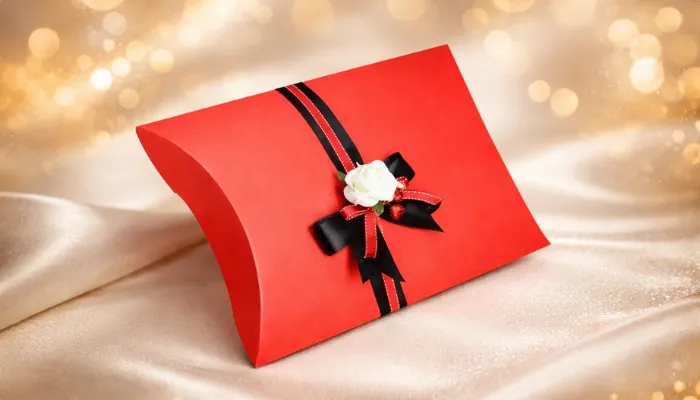
Preparing Your Artwork File for Custom Pillow Box Printing
Print-ready artwork for custom pillow boxes must be provided as a CMYK PDF or AI file at 300 DPI minimum, with 3mm bleed, correct safe zones, all fonts outlined (converted to curves), and all linked images embedded — placed on the correct dieline for the specific box size being ordered.
The Print-Ready Artwork Checklist
Before submitting artwork to U Custom Packaging, verify all of the following:
- File format: PDF (preferred), AI, or EPS — not JPEG, PNG, or Word documents
- Color mode: CMYK — not RGB. Convert all elements to CMYK before saving
- Resolution: All raster elements (photographs, textures) at 300 DPI minimum at actual print size
- Bleed: 3mm bleed beyond all cut lines on all edges
- Safe zone: All critical text and logos at least 3mm inside all cut lines
- Fonts: All fonts outlined/converted to curves — eliminates font substitution issues if the recipient does not have the same fonts installed
- Images embedded: All linked images embedded in the file, not linked to external files
- Dieline layer: The dieline should be on a separate layer, set to overprint, and clearly labeled
- Spot UV layer: If spot UV is required, provide a separate file showing the spot UV areas in 100% black
- Foil layer: If foil stamping is required, provide a separate file showing the foil area in 100% black
What Happens If Artwork Is Not Print-Ready
Artwork that does not meet print-ready standards causes production delays, unexpected color shifts, and blurry or pixelated printing. Common issues:
- RGB artwork converted to CMYK at the press — colors shift unpredictably. Always convert to CMYK in the design file
- Low-resolution logos — logos provided as JPEGs from websites are typically 72 DPI and will print blurry. Always provide vector logo files (AI or EPS) from your graphic designer
- Missing bleed — white unprinted edges appear at the cut margins. Always extend artwork 3mm beyond cut lines
- Text too close to cut lines — text gets partially cut off during die-cutting
U Custom Packaging’s free design support team can assist with all of these issues — contact us before placing your order if you are unsure about your artwork’s print-readiness.
Custom Printed Pillow Boxes for Different Order Quantities
Custom printed pillow boxes are available at any quantity — from single samples through small runs of 25–100 units for product launches, medium runs of 100–500 for growing retail brands, and large wholesale runs of 500+ for established retailers and high-volume e-commerce brands.
Small Runs (25–100 units) — Digital Printing
Ideal for: Product launches, market testing, seasonal limited editions, event-specific designs, wedding favors.
Printing method: Digital printing — no plate costs, full design flexibility, fast turnaround.
Per-unit cost: Higher than offset but accessible without committing to large quantities.
Medium Runs (100–500 units) — Digital or Offset
Ideal for: Growing retail brands, e-commerce businesses, subscription box programs, boutique wholesale.
Printing method: Digital printing remains cost-effective and flexible up to approximately 500 units; offset printing becomes more competitive above 300–500 units depending on design complexity.
Per-unit cost: Significantly lower than small-run digital pricing.
Large Runs (500+ units) — Offset or Flexographic
Ideal for: Established retail brands, national distribution, high-volume e-commerce, major wholesale programs.
Printing method: Offset printing for premium color accuracy; flexographic for maximum cost efficiency on simpler designs.
Per-unit cost: The lowest available per-unit pricing — the most cost-effective point for the custom printed pillow box format.
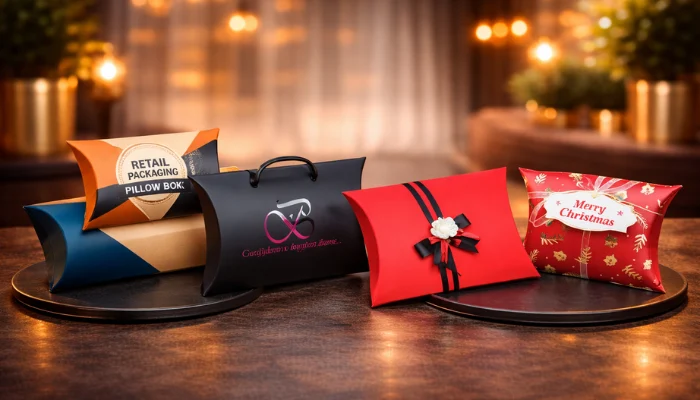
Why Choose U Custom Packaging for Custom Printed Pillow Boxes USA?
U Custom Packaging is a trusted supplier of custom printed pillow boxes for brands across the USA — delivering consistent print quality, genuine design and pre-press expertise, and flexible ordering at every scale.
- ✅ No Minimum Order Quantity — order as few or as many as your business requires
- ✅ Free Custom Design Support — dieline setup, artwork preparation, pre-press file checking, and revisions included
- ✅ All Printing Methods Available — digital, offset, flexographic, and screen printing
- ✅ All Pillow Box Materials — kraft, SBS white board, coated art paper, recycled board
- ✅ Full Range of Finishing Options — matte, gloss, soft-touch lamination, foil stamping, embossing, spot UV
- ✅ PMS Color Matching Available — for brand-critical color accuracy across production runs
- ✅ Food-Safe Ink Options — for candy, chocolate, and artisan food pillow boxes
- ✅ White Ink Printing on Kraft — for full-color designs on natural brown kraft board
- ✅ Free Shipping Across the USA — on all qualifying orders
- ✅ 4–8 Business Day Turnaround — with RUSH production available
- ✅ 3D Mockups and Printed Samples — available before bulk production
Frequently Asked Questions About Custom Printed Pillow Boxes USA
What is the difference between custom printed pillow boxes and plain pillow boxes?
Custom printed pillow boxes have a brand’s logo, colors, and design printed directly onto the box surface — transforming a functional packaging container into a brand communication tool. Plain pillow boxes are unprinted generic packaging with no branding. The printing is what makes pillow boxes work as a marketing asset rather than just as a container.
What printing method is best for custom pillow boxes with logo?
For small orders and complex designs, digital printing is best — no minimum quantities, full color, fast turnaround. For large orders requiring PMS color accuracy, offset printing delivers the best results. For simple bold logos on kraft, screen printing or flexographic printing are the most cost-effective options.
What file format should I submit for custom printed pillow box artwork?
Print-ready artwork should be submitted as a CMYK PDF or Adobe Illustrator (AI) file at 300 DPI minimum, with 3mm bleed on all edges, fonts outlined, and all images embedded. PNG and JPEG files are not suitable for production printing. U Custom Packaging’s free design team can help prepare your files if needed.
Can I print in full color on natural kraft pillow boxes?
Yes. Full-color CMYK printing on natural brown kraft requires a white ink base layer printed first to create an accurate color surface. Without a white ink base, CMYK colors appear muted and warm due to the brown substrate showing through. Some brands intentionally omit the white base for a warmer, more artisan aesthetic — both approaches are available.
What is the minimum order quantity for custom printed pillow boxes?
U Custom Packaging has no minimum order quantity. You can order as few custom printed pillow boxes as you need — one unit for a sample, 25 for a small launch, or 10,000 for a national retail program.
How do I ensure my brand colors print accurately on pillow boxes?
For the most accurate brand color reproduction, specify your colors by PMS (Pantone) number and request PMS-matched printing. For CMYK printing, provide CMYK color values rather than RGB or hex codes. Always request a printed proof or color proof before approving full production runs.
What is a dieline and do I need one for custom pillow box printing?
A dieline is the flat template showing the exact dimensions, cut lines, and fold lines of your pillow box before assembly. Yes — you need to design your artwork on the correct dieline for your specific box size. Using the wrong dieline or a generic template can result in misaligned artwork when the box is assembled. U Custom Packaging provides the correct dieline for your box size as part of the free design support service.
Can I get foil stamping on custom printed pillow boxes?
Yes. Gold, silver, rose gold, copper, and holographic foil stamping are all available on custom pillow boxes. Foil stamping is applied as a finishing step after printing and lamination — it is not a printed color but a physically applied metallic film. It is one of the most visually impactful premium treatments available for pillow box packaging.
What finish is most popular for custom printed pillow boxes?
Matte lamination is the most popular finish across all pillow box categories — it creates a sophisticated, non-reflective surface that photographs well and feels premium in hand. Soft-touch matte lamination is the premium version, adding a velvety tactile quality. Gloss lamination is preferred for candy, food, and brightly colored retail applications where color vibrancy is the priority.
Are food-safe inks available for custom printed pillow boxes?
Yes. Food-safe inks compliant with FDA requirements for indirect food contact packaging are available for all custom pillow boxes used for food products — chocolates, candy, cookies, artisan treats, and specialty food gifting. Always specify food-safe requirements when placing your order.
How long does it take to produce custom printed pillow boxes?
Standard production turnaround at U Custom Packaging is 4–8 business days from design approval. Rush production is available for urgent orders. Free shipping is included on all qualifying orders to any US address.
What is the difference between embossing and foil stamping on pillow boxes?
Embossing creates a raised three-dimensional impression in the box surface — the logo or design element stands above the surrounding material, visible through texture and shadow. No metallic element is involved. Foil stamping applies a metallic film to the surface using a heated die — the result is a flat, mirror-like metallic accent. Both can be used separately or combined (foil + emboss) for maximum premium impact.
Conclusion
Custom printed pillow boxes are packaging that works as hard as your product does — building brand recognition, communicating quality, and driving purchase decisions every time they are seen by a customer or bystander.
The quality of the printing is what determines how effectively the box performs these functions. The right printing method for your design and order size, the right color strategy for your substrate and brand positioning, correctly prepared artwork that prints cleanly and accurately, and the right finish to deliver the tactile and visual experience your brand requires — these are the decisions that separate packaging that represents your brand well from packaging that undermines it.
Whether you need 25 digital-printed kraft pillow boxes with a white ink logo for a product launch, 500 offset-printed white board pillow boxes with PMS-matched brand colors for a retail program, or 5,000 foil-stamped soft-touch pillow boxes for a national jewelry brand, U Custom Packaging delivers custom printed pillow boxes across the USA with free design support, no minimum order quantity, and free shipping.
Ready to get your custom printed pillow boxes designed and produced?
Get your free instant quote from U Custom Packaging today.