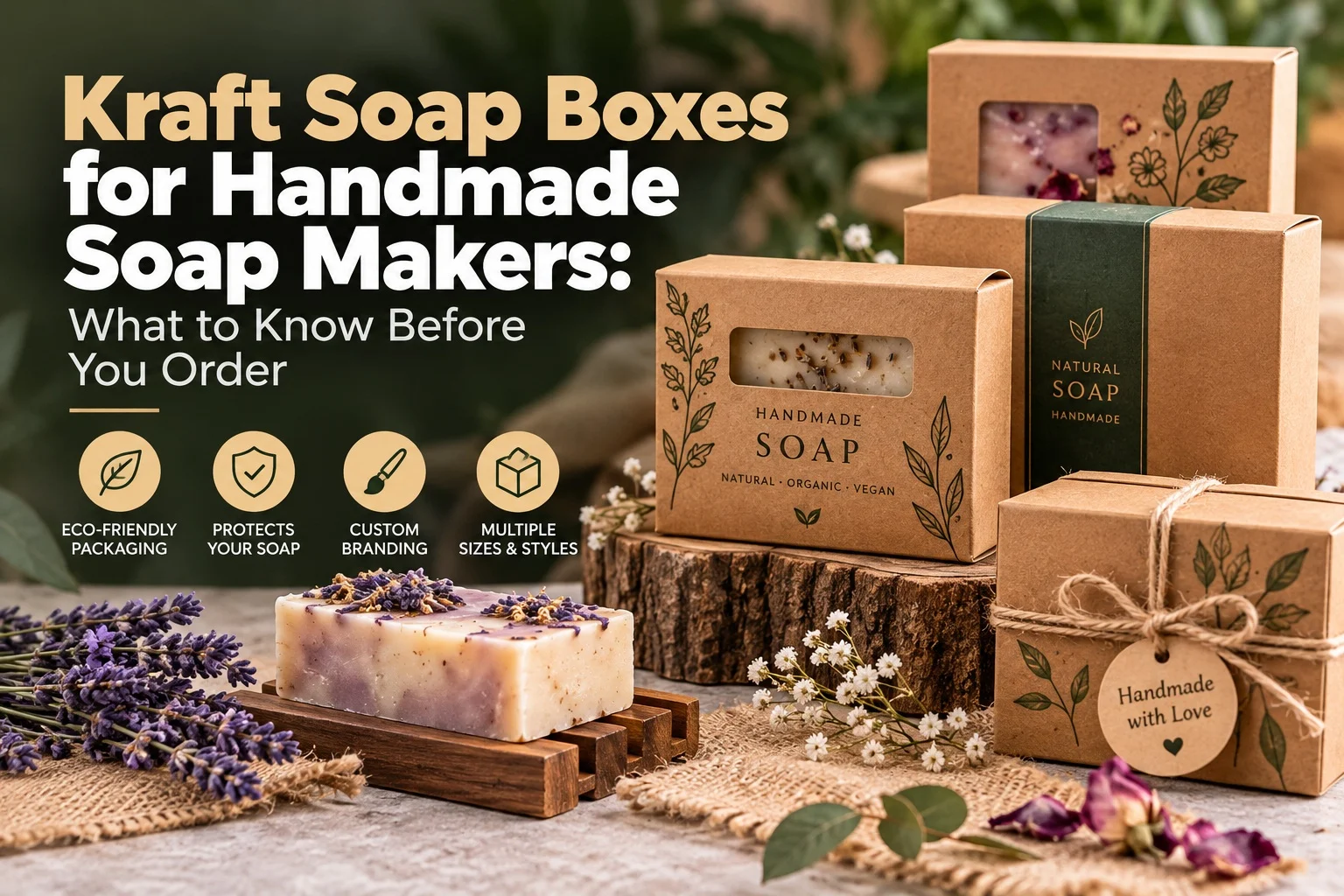
Two soap makers sell side by side at a holiday market. Both use quality ingredients. Both charge about the same. You can order these as our custom kraft soap boxes, printed in your size, material and finish.
One wraps bars in loose paper. The other uses snug kraft boxes with a small window, so shoppers can see the swirl and read the scent name without picking anything up. By midday, the second table has a line.
Handmade soap is a product people judge with their eyes and their hands before they ever smell it. The box does the first impression for you. But a kraft soap box also has to do practical work: fit a bar properly, handle a bit of moisture, and survive being handled by dozens of customers.
This guide covers the decisions that matter most when you’re buying kraft soap boxes for handmade soap: sizing, moisture and oil concerns, windows, printing on kraft, and how to place a sensible first order.
Why Soap Makers Choose Kraft
Kraft paperboard has a natural, uncoated look that matches how most handmade soap is positioned: simple, ingredient-focused, and made in small batches. Customers read it as honest and artisan without you saying a word.
Kraft also prints in a particular way. Because the base is brown rather than white, inks look warmer and more muted, and very bright colors lose punch. Dark inks, one-color logos, and foil accents tend to look best. If your brand relies on vivid pinks or neon tones, white stock may serve you better; if your brand is earthy, botanical, or minimal, kraft is a natural match.
Sizing: The Mistake That Costs the Most
Soap bars are not uniform. A cold-process bar cut by hand varies by a few millimeters between pieces, and bars shrink slightly as they cure. Order a box that fits your fresh bar exactly and you may end up with a loose fit later.
Measure several finished, fully cured bars, not just one. Use the largest as your reference, then add a small allowance so a bar slides in without force. A snug fit keeps bars from rattling; a too-tight fit scuffs edges and makes packing slow.
If you make bars in more than one shape, order separate sizes instead of forcing everything into one box.
Moisture, Oils, and Barrier Concerns
Soap can sweat, especially glycerin-rich bars in humid weather, and some bars leave a faint oil mark on uncoated paper over time. Plain kraft is absorbent.
Practical ways to handle it:
- Let bars cure fully before boxing, so excess moisture has evaporated.
- Wrap the bar first in a thin paper or film layer if your recipe tends to sweat.
- Ask about coatings or liners if you sell in humid climates or ship over long distances.
Test a sample box with your actual bar for a couple of weeks before committing to a large run. It’s the cheapest way to find out how your specific recipe behaves.
Window or No Window?
A window cutout lets customers see color and swirl, which is a strong selling point for visually striking soaps. It also exposes the bar to air and handling, and adds a small cost.
A window works well when the soap’s appearance is the main draw. A solid box works better for plain bars, strongly scented soaps where you want to control exposure, or minimalist branding where the box itself is the visual.
Printing on Kraft: Keep It Simple
For most soap brands, simple printing performs best on kraft:
- One- or two-color printing in dark brown, black, or deep green
- Foil stamping for a premium accent on gift soaps
- Embossing for a tactile logo customers can feel
Keep your logo readable from about 3 feet away, and don’t crowd the front panel. The scent name, soap type, and your brand should be the first three things a shopper can read.
For design details, see our kraft soap box design and printing guide.
What Goes on the Box: Labeling
Soap labeling rules depend on how your product is classified and where you sell. Many soap makers include ingredients, net weight, and business information on the box. Requirements vary, so check the guidance that applies to your product type and market before you finalize artwork, rather than assuming.
A Simple Ordering Checklist
Have these ready before you request a quote:
- Measured dimensions of your fully cured bar
- First-run quantity
- Window or solid, and any liner or coating needs
- Print approach (one color, two color, foil, embossing)
- Logo as a vector file (AI, EPS, or PDF)
- Target delivery date, with buffer
Direct Answers to Common Buyer Questions
What is the minimum order for custom kraft soap boxes? Minimums start from 25 boxes at UCustomPackaging, so you can test a design before ordering at volume.
How long does production take? About 7 business days, plus shipping time.
What file format do I need? A vector file in AI, EPS, or PDF format.
Can I get a sample first? Yes, you can request a physical sample to check fit, color, and how kraft handles your bar.
Are kraft boxes recyclable? Kraft paperboard is typically recyclable, but coatings, laminates, or foil can affect that. Ask about the specific finish you choose.
Quick Reference: Kraft Soap Boxes for Handmade Soap
Kraft soap boxes are uncoated brown paperboard boxes sized to hold bar soap, and they are popular with handmade and small-batch soap makers because their natural look matches artisan positioning. They protect bars during handling and give you a surface for your logo, scent name, and product details.
The key decisions are size, moisture protection, and printing. Size should be based on several measured, fully cured bars plus a small allowance, since hand-cut bars vary and shrink as they cure. Moisture matters because plain kraft is absorbent, so sweating or oily bars may need wrapping, a liner, or a coating. Printing works best on kraft with dark one- or two-color inks, foil, or embossing, since bright colors appear muted on a brown base.
For production, minimum orders start from 25 boxes, production takes about 7 business days before shipping, vector logo files are required, and physical samples are available before a full order.
Where to Start
Begin with one bar size, one simple print design, and a small first run. Test a sample with your real soap, photograph it the way customers will see it, and adjust before scaling up.
When you’re ready, explore our custom kraft soap boxes with logo printing, window options, and low minimums for soap brands across the United States.
For the sustainability side of kraft packaging, read our post on eco-friendly kraft soap boxes for artisan brands.
FAQ
- Why use kraft boxes for handmade soap? Kraft has a natural, uncoated look that matches the handmade, ingredient-focused image most soap brands want. It’s affordable, prints well with simple designs, and is typically recyclable. The warm brown tone makes soap look artisan and giftable. It also suits minimalist branding where the box itself carries the style.
- How do I choose the right size for my soap bars? Measure several fully cured bars and use the largest as your reference. Add a small allowance so a bar slides in without force. Hand-cut bars vary and shrink while curing, so measuring one fresh bar can lead to a loose fit. Test with a sample before ordering a full run.
- Will soap damage a kraft box? It can, if the bar sweats or leaves oil, because plain kraft is absorbent. Fully curing bars before boxing reduces the risk. Wrapping the bar in a thin paper or film layer, or asking about a liner or coating, adds protection. A two-week sample test with your actual recipe tells you how it behaves.
- Should I choose a window box? A window shows off color and swirl, which helps visually striking soaps sell. It also exposes the bar to air and handling and adds a small cost. Solid boxes suit plain or strongly scented bars. Choose based on whether appearance is your main selling point.
- What printing works best on kraft? Dark one- or two-color ink, foil stamping, and embossing work best on kraft. Bright colors like vivid pinks and neon tones look muted on a brown base. Keep the logo readable from about 3 feet away. Simple designs tend to look more premium on kraft than busy ones.
- What is the minimum order for custom kraft soap boxes? Minimum orders start from 25 boxes at UCustomPackaging. That makes it realistic to test a design before a bigger purchase. Larger quantities usually lower the per-box price. If you plan to reorder, ask about volume pricing.
- How long does production take? Production takes about 7 business days, with shipping time added. Timing can change with the print method and finish. If you have a market date or launch, add a buffer beyond the stated window. Rush options may be available for urgent orders.
- What file format do I need for my logo? You need a vector file in AI, EPS, or PDF format. Vector artwork stays sharp at any size, which matters for small soap boxes. A low-resolution JPEG or PNG can print blurry. A designer can convert a raster logo to vector if needed.
- Can I get a sample before ordering? Yes, you can request a physical sample before a full run. A sample lets you check fit, kraft color, and print quality with your real soap. Screen colors rarely match print, so this step prevents costly mistakes. It’s worth doing on any first order.
- Are kraft soap boxes recyclable? Plain kraft paperboard is typically recyclable. Coatings, laminates, and some foils can change that, so ask about your specific finish. If sustainability is part of your brand story, choose simple printing and minimal coatings. Mention recyclability on the box only after confirming it applies to your finish.