

Imagine two products sitting side by side on a retail shelf.
They use the exact same box structure. The dimensions are identical. The graphics are identical. Even the product inside is identical.
The only difference?
One package uses matte lamination with a spot UV logo. The other uses a standard gloss coating.
Same product. Same price. Different finish.
In packaging tests and real-world retail environments, customers consistently perceive the matte version as more premium before they’ve read a single word or evaluated the product itself.
That’s the power of packaging finishes.
Many brand owners think finishing techniques exist simply to make packaging look better. In reality, finishes influence how customers touch, view, photograph, and judge a product. They affect perceived quality, brand positioning, and even social media performance.
Packaging finishes influence purchase decisions within 7 seconds of first contact – tactile and visual finish quality consistently affects perceived product value across retail categories.
If you’re evaluating packaging upgrades, understanding what each finish actually does—and when it delivers a worthwhile return—can help you spend your packaging budget far more effectively.
Why Packaging Finishes Matter Beyond Aesthetics
Customers interact with packaging through sight and touch long before they experience the product itself.
That interaction creates immediate psychological signals.
Different finishes communicate different messages:
- Rough textures → artisan, handmade
- Smooth matte → luxury, modern
- Reflective gloss → energetic, vibrant
- Metallic surfaces → premium, celebratory
- Raised elements → craftsmanship and quality
This creates what’s often called the “halo effect.”
When packaging feels premium, customers frequently assume the product inside is premium as well.
Studies show customers associate premium packaging textures with higher product quality—even when product quality is identical across different packaging variants.
Finishes Influence Social Media Performance
Packaging today doesn’t live only on store shelves.
It lives on:
- TikTok
- YouTube unboxing videos
- Product photography
- User-generated content
The way light interacts with your packaging directly affects how well it photographs.
Some finishes enhance content creation.
Others create glare, reflections, or flat-looking visuals.
For ecommerce and social-first brands, this matters more than ever.
Matte Lamination – The Premium Default
Matte lamination is one of the most popular premium packaging finishes available today.
What Matte Lamination Does
Matte lamination applies a thin protective film over printed packaging surfaces.
Unlike gloss, matte absorbs light rather than reflecting it.
The result is a smooth, sophisticated appearance.
Why Matte Became the Premium Standard
Matte packaging offers several advantages:
- Feels expensive without appearing flashy
- Reduces photography glare
- Creates visual depth
- Supports minimalist design aesthetics
- Adds surface protection
This combination explains why matte packaging dominates many premium product categories.
Where Matte Performs Best
Matte packaging works exceptionally well for:
- Cannabis packaging
- Wellness products
- Luxury skincare
- Premium cosmetics
- High-end apparel packaging
- Specialty food brands
Many brands featured in discussions about Eco Cannabis Packaging and Custom Cosmetic Boxes rely heavily on matte finishes because they support modern premium positioning.
Where Matte Underperforms
Matte isn’t ideal for every product.
It often struggles with:
- Bright candy packaging
- Children’s products
- Highly energetic branding
- Products requiring vibrant color intensity
Photography Performance
Matte is highly camera-friendly.
It minimizes reflections and allows product photography to appear cleaner and more professional.
This is a major reason social-media-focused brands often prefer matte finishes.
Cost Context
Matte lamination is among the most affordable premium packaging finishes available.
In many production runs, it costs only marginally more than standard gloss coating.
For brands seeking maximum visual upgrade with limited budget, matte often delivers the strongest return.
Gloss Coating – Bold and Vibrant
Before matte became dominant, gloss was the packaging industry’s default finish.
It remains highly effective in specific situations.
What Gloss Coating Does
Gloss coating increases light reflection.
Colors appear brighter, richer, and more saturated.
Why Gloss Still Works
Gloss offers several advantages:
- Vibrant graphics
- Strong shelf visibility
- Enhanced color intensity
- Excellent performance under retail lighting
Where Gloss Performs Best
Gloss works especially well for:
- Snack packaging
- Candy products
- Children’s brands
- Promotional packaging
- Bright consumer goods
- High-volume retail products
Where Gloss Underperforms
Gloss often works against:
- Luxury positioning
- Premium wellness products
- Minimalist design systems
- Sophisticated gifting products
Photography Performance
Gloss creates reflections.
Those reflections can sometimes make social content difficult to capture.
Brands focused heavily on ecommerce photography often find matters easier to manage.
Cost Context
Gloss remains one of the most affordable finishing options.
For mass-market retail products, it frequently provides the best balance of cost and visual impact.
The simple rule:
If your brand is energetic and bold, gloss amplifies it.
If your brand is refined and minimalist, gloss often works against it.
Spot UV — Selective Contrast
Spot UV is one of the most strategically useful premium packaging finishes available.
What Spot UV Does
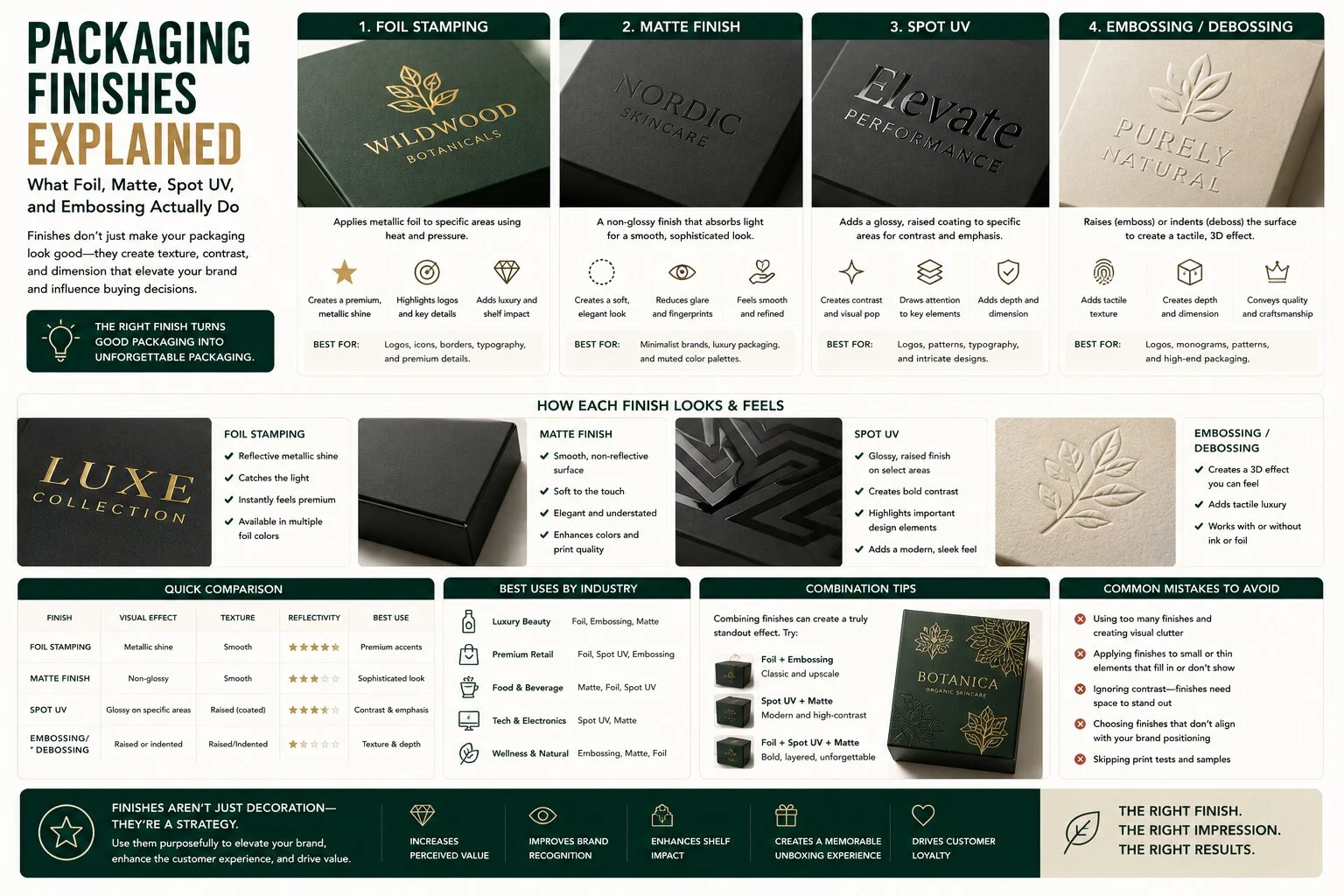
Spot UV applies a raised glossy coating to specific design elements rather than the entire package.
Common targets include:
- Logos
- Product names
- Decorative graphics
- Brand symbols
Why Selective Contrast Works
The effectiveness comes from contrast.
A glossy logo against a matte background naturally attracts attention.
The eye moves toward reflective surfaces.
This creates visual hierarchy without changing the design itself.
Most Effective Applications
Spot UV works best for:
- Logo highlighting
- Product title emphasis
- Premium graphic accents
- Strategic focal points
Matte + Spot UV
This combination remains one of the most effective premium packaging finishes available.
The interaction between matte and gloss creates depth, sophistication, and strong visual engagement.
Photography Performance
Spot UV performs exceptionally well in close-up photography.
Content creators frequently capture packaging angles specifically to showcase reflective spot UV details.
Cost Context
Spot UV adds noticeable production cost.
Because of this, it’s usually best reserved for high-impact design elements rather than large coverage areas.
Foil Stamping — Metallic Impact
Few packaging finishes attract attention as effectively as foil stamping packaging.
What Foil Stamping Does
Foil stamping uses heat and pressure to transfer metallic film onto packaging surfaces.
Unlike printed metallic ink, foil physically reflects light.
Common Foil Options
Popular foil choices include:
- Gold foil
- Silver foil
- Copper foil
- Rose gold foil
- Holographic foil
Each communicates a slightly different brand personality.
Where Foil Performs Best
Foil stamping packaging excels in:
- Luxury cosmetics
- Premium CBD products
- Corporate gifting
- Candle packaging
- High-end food packaging
- Luxury subscription boxes
Why Foil Works
Foil interacts dynamically with light.
As viewing angles change, the appearance changes.
Printed graphics cannot replicate this effect.
Photography Performance
Gold foil performs especially well in natural light photography.
Many luxury brands intentionally design packaging to create foil highlights in social content.
Cost Context
Foil stamping requires:
- Custom dies
- Additional setup
- Additional production passes
Costs are significantly higher than standard coatings.
However, perceived value often increases substantially when foil is used strategically.
Embossing and Debossing — Tactile Identity
Some packaging finishes are designed to be felt as much as seen.
What Embossing Does
Embossing pushes design elements outward.
Logos and graphics become raised above the surface.
What Debossing Does
Debossing creates recessed impressions.
Design elements appear pressed into the packaging.
Why Tactile Finishes Matter
Customers naturally touch packaging.
Raised or recessed elements create memorable physical interactions.
This strengthens brand recall.
Best Applications
Embossing packaging performs particularly well on:
- Logos
- Brand marks
- Product names
- Decorative borders
- Texture patterns
Blind Embossing
Blind embossing uses no foil or ink.
The effect comes entirely from texture.
It works exceptionally well on kraft materials and premium minimalist packaging.
Embossing + Foil
Combining embossing with foil creates one of the strongest premium packaging finishes available.
Customers see the enhancement and feel it simultaneously.
Photography Performance
Embossed details create shadows and highlights that add depth to product photography.
Professional photographers frequently use directional lighting specifically to emphasize embossed surfaces.
Cost Context
Embossing packaging requires custom dies and additional production steps.
It becomes most cost-effective on larger production volumes.
Soft-Touch Coating — The Velvet Effect
Soft touch packaging has become increasingly popular among luxury brands.
What Soft-Touch Coating Does
Soft-touch coating creates a velvet-like surface texture.
The effect is subtle visually but immediately noticeable when handled.
Why Soft-Touch Works
Benefits include:
- Instant premium perception
- Luxurious tactile experience
- Reduced light reflection
- Enhanced photography depth
Best Applications
Soft-touch packaging performs exceptionally well for:
- Luxury cosmetics
- Premium cannabis products
- High-end skincare
- Technology accessories
- Corporate gifts
The Soft-Touch + Gold Foil Combination
Among all premium packaging finishes, this remains one of the most consistently successful combinations.
Soft-touch absorbs light.
Gold foil reflects light.
The contrast creates immediate premium perception.
Photography Performance
Soft-touch surfaces photograph beautifully.
They create rich shadows, depth, and texture that translate exceptionally well to ecommerce imagery.
Cost Context
Soft-touch costs more than standard matte packaging.
It is typically best justified for products retailing above $40–50.
Choosing the Right Finish for Your Packaging
Different brands require different finishing strategies.
Artisan and Natural Brands
Recommended:
- Matte lamination
- Soft-touch coating
- Copper foil accents
- Blind embossing
Avoid:
- Heavy gloss
- Holographic foil
Cannabis and CBD Brands
Recommended:
- Matte packaging as standard
- Spot UV logos
- Silver foil
- Gold foil for premium collections
Many sustainability-focused cannabis brands also combine these finishes with FSC-certified materials as discussed in Eco Cannabis Packaging.
Luxury and Gift Products
Recommended:
- Soft-touch base
- Gold foil
- Embossing packaging
- Spot UV accents
This approach works especially well on premium rigid boxes and luxury gifting programs.
Food and Snack Brands
Recommended:
- Gloss coating
- Spot UV highlights
Avoid:
- Overly luxurious finishes that conflict with category expectations
Ecommerce and Subscription Brands
Recommended:
- Matte or gloss depending on positioning
- One premium finish such as foil or spot UV
- Interior printing for unboxing enhancement
The goal is balancing customer experience with production efficiency.
Conclusion
The best packaging finishes are not necessarily the most expensive ones. They are the finishes that align with your brand personality, product price point, customer expectations, and retail environment.
Matte packaging communicates modern sophistication. Gloss creates energy and shelf visibility. Spot UV adds strategic contrast. Foil stamping packaging delivers metallic luxury. Embossing packaging creates memorable tactile interaction. Soft touch packaging elevates premium perception through feeling alone.
If you’re working with a limited budget, matte lamination combined with a spot UV logo often delivers the strongest visible improvement for the lowest investment.
Explore our custom packaging boxes with premium finishing options including foil stamping, matte lamination, soft-touch coating, and embossing for brands across the United States.